

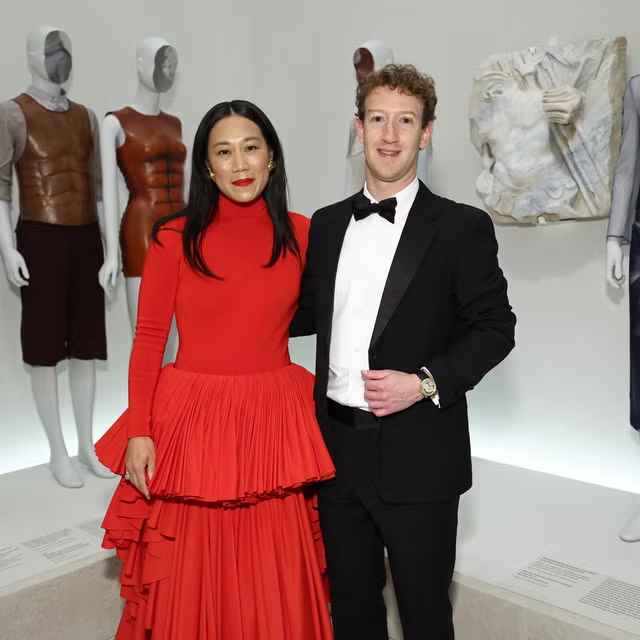
Last night was the annual Met Gala in New York City.
Now, let me say this right up front: I am wildly unqualified to discuss celebrity fashion. I know what I like. I know what looks expensive. And I know when someone appears to be wearing a chandelier, a taxidermy swan, or the emotional burden of being famous.
But as my socials were flooded with pictures of beautiful people in outfits that looked like they required permits, forklifts, and possibly a small advisory board, it occurred to me that church leaders might actually have something to learn from the Met Gala.
And since this platform lives at the intersection of pop culture and church leadership, this feels like exactly the sort of glitter-covered case study we should probably poke with a stick.
Mark Zuckerberg posted a picture of himself and his wife on Instagram with the caption, “date night.”
Which is adorable.
But the Met Gala is not exactly dinner and a movie.
For the uninitiated, the Met Gala is an invite-only fundraiser for The Metropolitan Museum of Art’s Costume Institute. It is widely known as “fashion’s biggest night,” and this year’s event reportedly raised an estimated $31 million.
Designers spend months creating gowns, suits, costumes, statements, sculptures, and whatever category “Katy Perry descending from another realm” falls into. Celebrities, influencers, billionaires, musicians, actors, athletes, and cultural power players walk the red carpet in meticulously timed arrivals designed to give each person their moment. But if your goal is to get people’s attention, then everyone arriving at the same time, waiting in traffic, stepping over each other on the red carpet, and rushing in to the event at the last minute would work against the goal.

This is not people randomly showing up at a fancy party.
This is choreography.
It is high-cost, high-pressure, high-glamour theater. To be seen arriving at the Met is to arrive in pop culture.
So what in the world can church leaders learn from the Met Gala?
Three things stand out:
- Timing matters
- Attention matters
- Buy-in from key influencers matters
And yes, I know. That sounds like a church staff meeting wearing couture.
1. Timing Matters
The Met Gala red carpet is carefully orchestrated so every major arrival gets its own moment. People are not all pulling up at once, tripping over each other’s gowns, blocking photo angles, and yelling, “Excuse me, Zendaya, I think that’s my Uber.”

The timing is the strategy.
Because if the goal is attention, then chaos works against the goal.
Church leaders need to hear that.
Timing matters.
We sometimes act like planning is somehow less spiritual than spontaneity. It is not.
Yes, the Holy Spirit can move without a service schedule. Absolutely. God is not anxiously refreshing Planning Center while wondering if the bridge is going too long.
And yes, spontaneous moments can become holy moments. Sometimes the thing you did not plan becomes the thing everyone remembers.
But that does not mean timing is irrelevant.
If your service regularly drags because every transition has the urgency of a DMV waiting room, people feel it. If your announcements become a second sermon, people feel it. If your worship set, offering moment, video, sermon, altar call, ministry update, and “quick word” from someone who has never once been quick all pile on top of each other, people feel it.
And your kids ministry volunteers really feel it.
A tighter service is not a less spiritual service. It is a more thoughtful one.
When we trim the excess, sharpen the transitions, and think through the experience, we make room for the moments that actually matter. The message lands better. Guests stay engaged longer. Volunteers do not have to white-knuckle through week after week of “just five more minutes,” which, in church math, means eighteen.
Timing also matters on the church calendar.
If you put a major kids event, women’s event, youth fundraiser, volunteer training, membership class, and outreach initiative all in the same two-week window, congratulations, you have not built momentum. You have built a blender.
People are not unlimited. Volunteers are not unlimited. Attention is not unlimited.
When we schedule strategically around natural momentum moments like Easter, Christmas, Mother’s Day, back-to-school, and the start of the new year, we do not have to manufacture all the energy ourselves. We can ride the wave that is already there.
And when we spread key events out, we give each one room to breathe.
Timing matters because people can only give their attention, energy, and participation to so many things at once. Great leaders do not just plan events. They sequence moments.
2. Attention Matters
The Met Gala is, first and foremost, a fundraiser.
But it became an institution because it mastered attention.
It is not just a dinner. It is not just a gala. It is not just a museum fundraiser. It is a cultural event that takes over social media for a night and fuels articles, rankings, memes, debates, hot takes, and fashion commentary from people like me who should probably not be allowed near the subject.
That attention creates value.
Attention brings designers. Attention brings celebrities. Attention brings media. Attention brings money. Attention brings momentum.
And before we get too churchy and pretend attention does not matter, let’s be honest. It does.

In the church, Jesus is not “part of the brand.” He is not the logo, the slogan, or the vibe. Jesus is the whole point. His Word, His presence, His mission, His Church. This is eternal stuff.
So why are we sometimes so weirdly casual about whether anyone is paying attention?
Yes, humility matters. No, we are not trying to become Christian influencers with fog machines and ring lights. But if Jesus called His people a city on a hill, maybe visibility is not the enemy. The question is not whether your church is getting attention. The question is what kind of attention you are getting.
Are you known for loving your city? Are you known for serving local schools? Are you known for feeding people, helping families, showing up in crisis, creating safe environments for kids, and being the kind of church your city would actually miss if you disappeared?
Or are you known as the church with the sad sign, the weird website, the angry Facebook comments, and the Sunday lunch crowd that makes servers question their calling? (That last one stings because it should.)
Churches are always communicating. The building communicates. The website communicates. The parking lot communicates. The kids check-in process communicates. The way people talk to guests communicates. The cleanliness of the bathrooms communicates. The way volunteers treat each other communicates. Everything speaks.
The Met Gala gets attention through spectacle. The Church should get attention through love, clarity, hospitality, beauty, generosity, and service. Not because we are trying to impress people. Because the message deserves to be heard.
3. Influencers Matter
Anna Wintour has presided over the Met Gala for decades, and her influence shapes the guest list, the tone, and the cultural gravity of the event. The room is filled with actors, musicians, designers, athletes, billionaires, models, politicians, and people whose job titles are basically “famous on purpose.”
The invite itself is a signal. It says, “You matter in culture.”
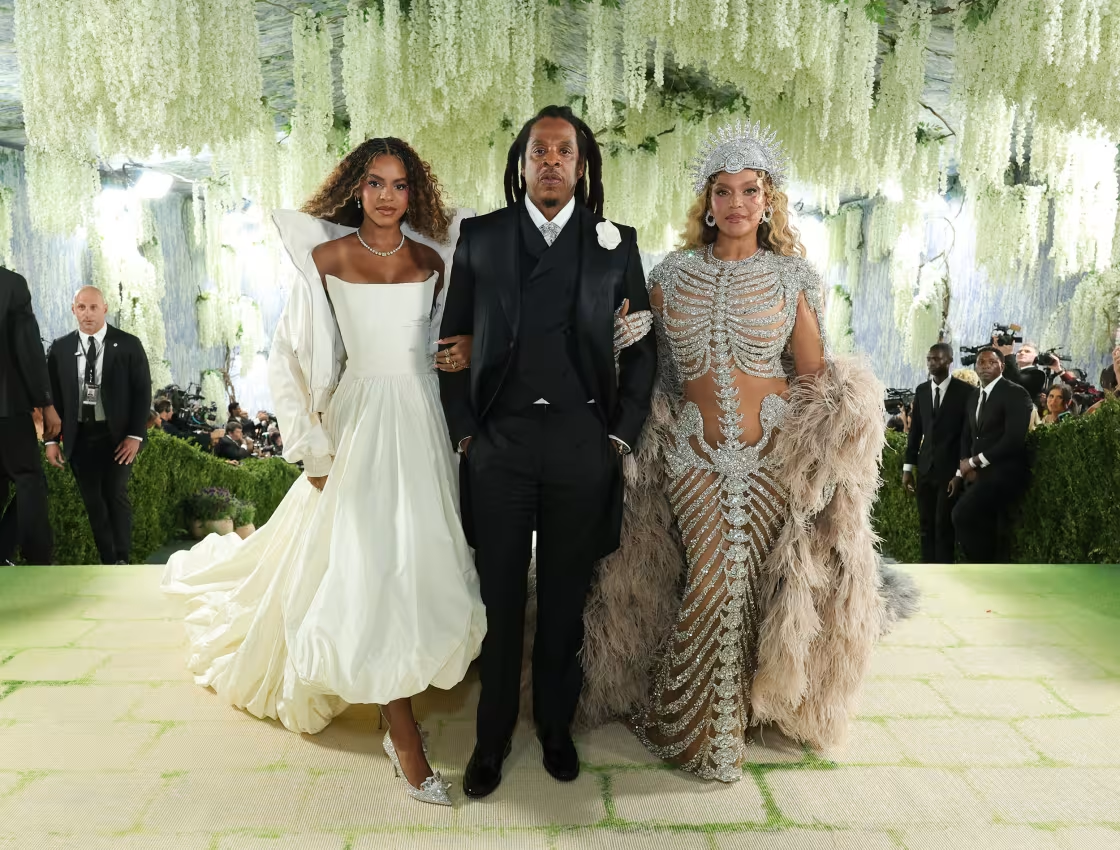
And because those people show up, their audiences show up too. Millions of people who will never attend the gala still watch, scroll, comment, argue, rank, and share. The reach multiplies because the right people are in the room.
Now, before someone gets nervous, I am not saying your church needs celebrities. I am saying leadership runs through relationship. Every church has influencers.
They may not have blue checks or designer gowns, but they have trust. They have relational weight. They have history. They have credibility. When they lean in, others lean in. When they are confused, others hesitate. When they are excited, momentum spreads faster than the lobby coffee disappears after second service.
This is why new initiatives cannot rely on branding alone. A sharp logo helps. A good announcement helps. A clean slide helps. A social media campaign helps. But if the key relational leaders in your church do not understand it, believe in it, or feel invited into it, the thing is going to wobble. You cannot market your way around a lack of trust. That does not mean manipulating people or using them for their influence. That is gross. Don’t be gross. It means doing the slow, human work of relationship.
Have the conversations before the announcement. Share the why before the what. Listen to concerns before you ask for support. Invite people in before you roll things out. When trusted people understand the vision and believe in it, their buy-in becomes a bridge for others. Momentum is not manufactured by hype. It is built through trust.
The Met Gala did not become the Met Gala overnight. It built reputation over time. People pay attention now because the event has trained the culture to expect something worth watching. Church leaders should pay attention to that. Not because we want to become flashy. Because we want to be trustworthy.
The Red Carpet Is Not the Point
It would be easy to dismiss the Met Gala as vapid, superficial, excessive, or worldly. And honestly? Some of it probably is. But that does not mean there is nothing to learn. Pop culture moments are case studies. We do not copy them. We study them. We ask why they work, what they reveal, and what wisdom can be redeemed without dragging the nonsense along with it.
So no, your church does not need a Sunday morning red carpet. Please do not make your greeters dress like museum docents and ask guests who they’re wearing.
But timing matters.
Attention matters.
Buy-in matters.
And leaders who understand those things will lead with more clarity, more intentionality, and more impact.
Now go make it work.
dc.

